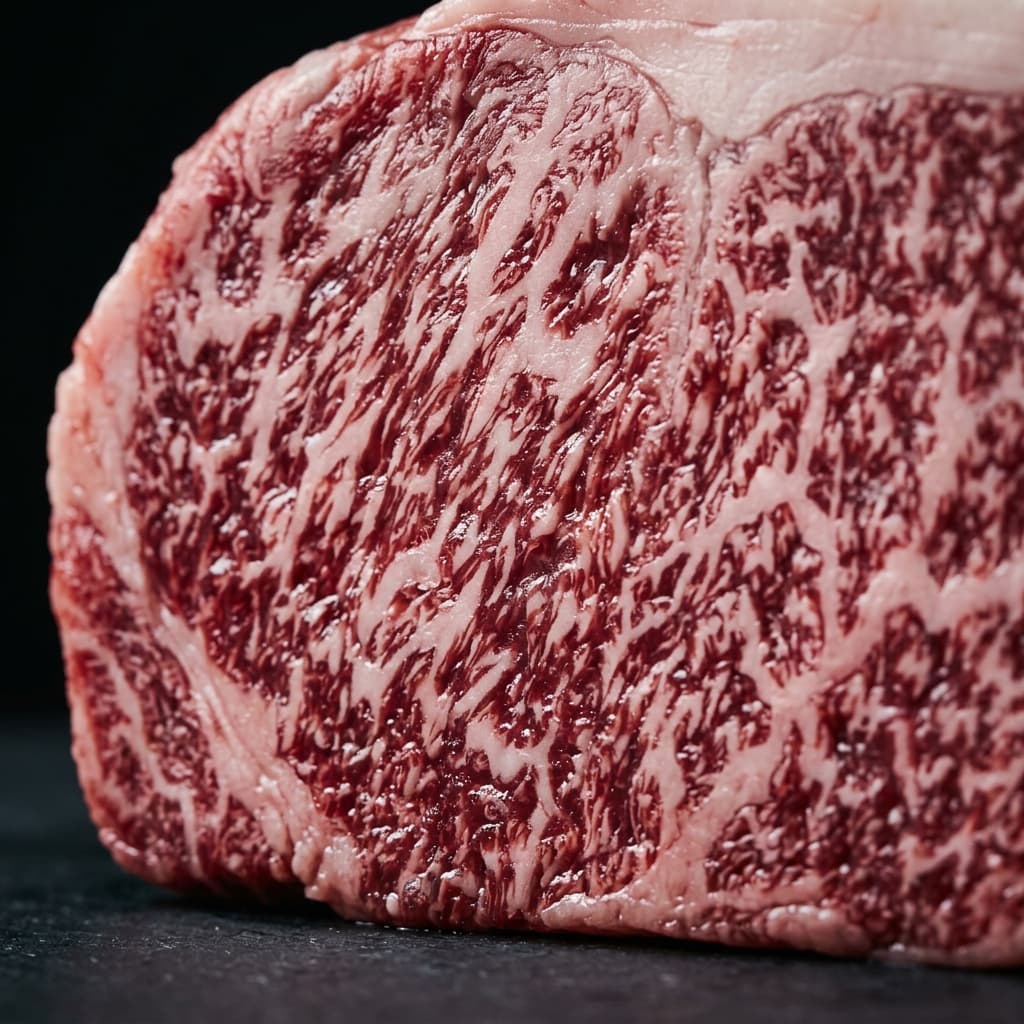
Japanese beef grading is widely considered the most precise and stringent system in the world. It is administered by the Japan Meat Grading Association (JMGA) and evaluates beef based on two primary dimensions:
Yield Grade (A–C)
Quantity of usable meat
Quality Grade (1–5)
Overall eating quality
The final grade combines both, resulting in classifications such as A5, A4, B3, etc.
1. Overall Grading Structure
Combined Grade Matrix
| Yield \ Quality | 5 (Excellent) | 4 (Very Good) | 3 (Good) | 2 (Average) | 1 (Poor) |
|---|---|---|---|---|---|
| A (High Yield) | A5 | A4 | A3 | A2 | A1 |
| B (Standard) | B5 | B4 | B3 | B2 | B1 |
| C (Low Yield) | C5 | C4 | C3 | C2 | C1 |
- A5 = highest possible grade
- A4 / A5 = Most premium exports
2. Yield Grade (A–C)
Yield grade measures how much usable meat can be obtained from the carcass.
Yield Calculation Concept
Yield is determined by measuring:
- Ribeye area
- Carcass weight
- Subcutaneous fat thickness
- Rib thickness
Yield Classification
Key Insight
Yield does not reflect eating quality — only efficiency of meat production.
3. Quality Grade (1–5)
Quality grade evaluates four core factors:
The lowest score among these factors determines the final quality grade.
4. Marbling Score (BMS)
The most important component is the Beef Marbling Score (BMS).
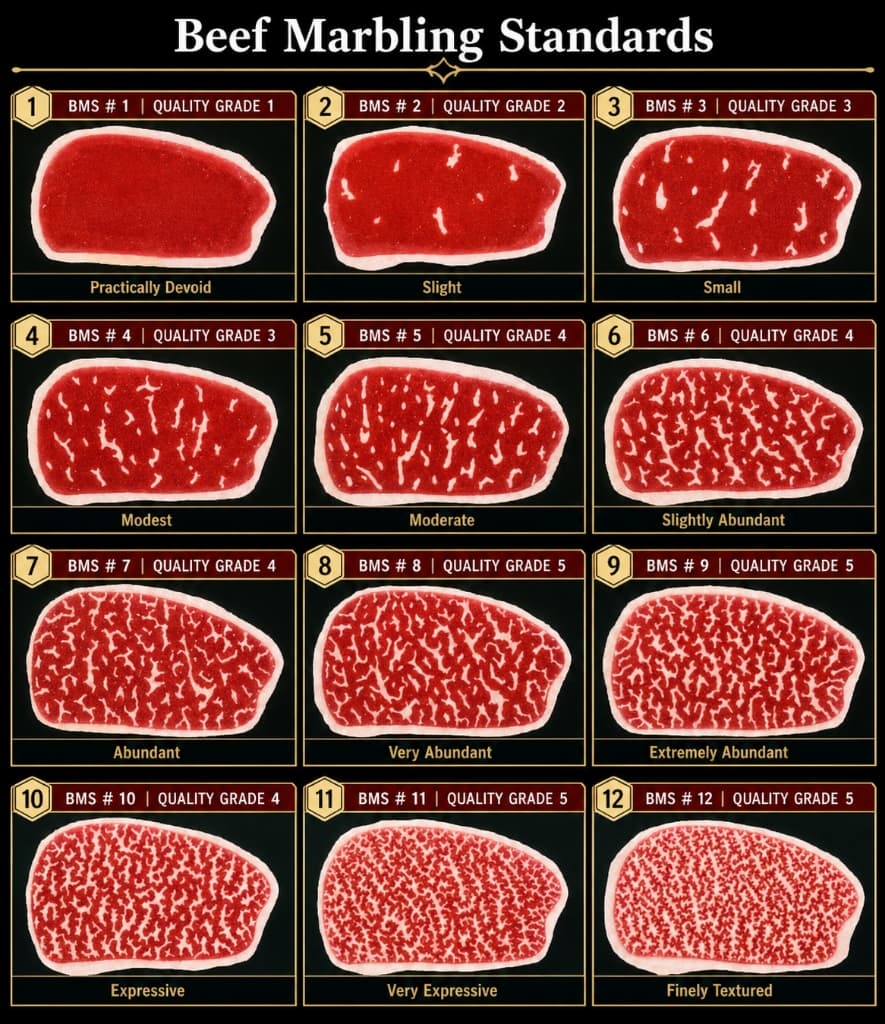
| BMS Score (1-12) | Quality Grade | Description |
|---|---|---|
| 1–2 | 1 | Very low marbling |
| 3–4 | 2 | Low marbling |
| 5–7 | 3 | Moderate marbling |
| 8–10 | 4 | High marbling |
| 11–12 | 5 | Extreme marbling |
Visual Density Representation (Text-Based)
Higher BMS = more intramuscular fat = richer flavor and tenderness.
5. Meat Color & Brightness (BCS)
Measured using a standardized color scale.
| BCS Level | Quality |
|---|---|
| 1–2 | Pale (undesirable) |
| 3–5 | Ideal red color |
| 6–7 | Dark (lower quality) |
Ideal beef falls within BCS 3–5.
6. Fat Quality & Color (BFS)
Fat is evaluated for color (white to creamy) and luster.
| BFS Level | Description |
|---|---|
| 1–2 | Poor (yellowish fat) |
| 3–5 | Ideal |
| 6–7 | Excellent |
7. Firmness & Texture
Assesses muscle fiber fineness and structural integrity.
8. Final Grade Determination Logic
Step-by-Step Process
- Step 1 Assign Yield Grade (A–C)
- Step 2 Score all 4 quality factors
- Step 3 Select the lowest quality score
- Step 4 Combine → Final Grade
Example Calculation
9. Grade Distribution (Typical Market Reality)
10. Comparison of Quality Sensitivity
Japanese System vs Others (Conceptual Precision)
| Factor | Japan | USA | Australia |
|---|---|---|---|
| Marbling Scale | 1–12 | 1–10 (approx) | 0–9 |
| Multi-factor grading | Yes | Limited | Moderate |
| Yield + Quality | Yes | Yes | Yes |
| Strictness | Very High | Moderate | High |
11. Key Characteristics of A5 Wagyu
- Marbling Extremely high
- Tenderness Maximum
- Flavor Rich, buttery
- Texture Melt-in-mouth
12. Simplified Visual Hierarchy
13. Critical Observations
- ◆ The Japanese system prioritizes precision and consistency.
- ◆ Marbling is the dominant factor but not the only one.
- ◆ Even A3 Wagyu can surpass many global beef standards.
- ◆ The system is designed for objective measurement, not subjective taste.